

The Perceptual Loudness Bias
In music production, the human brain perceives louder audio as sounding automatically clearer or punchier. When comparing two mix revisions where Mix B is 1 dB louder than Mix A, you will prefer Mix B regardless of whether your EQ or compression tweaks were actually improvements.
Sabes Pro resolves this using EBU R128 Loudness Matching.
How A/B Loudness Matching Works
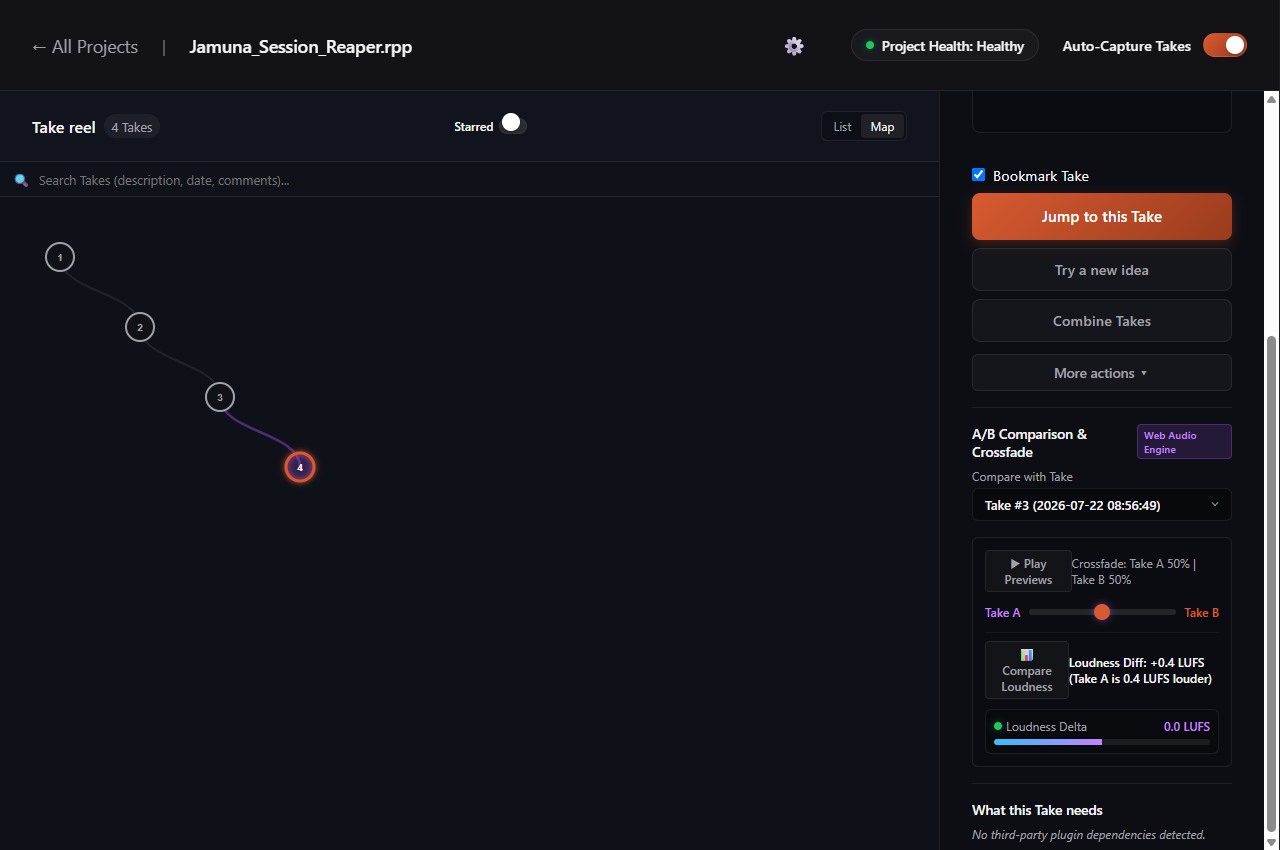
Sabes Pro measures integrated LUFS (Loudness Units Full Scale), Dynamic Range (LRA), and True Peak values across rendered Take bounces. When comparing Take A and Take B, Sabes Pro applies an automated gain offset to match perceived loudness during auditioning.
Step-by-Step Auditing Guide
1. Select Two Take Nodes
On your Take Reel timeline, select your baseline Take (e.g. Mix_Pass_01) and hold Shift to select a second Take (e.g. Mix_Pass_02).
2. Launch A/B Comparison
Click Compare A/B Loudness in the action bar. Sabes Pro analyzes the audio bounces linked to both Takes.
3. Review EBU R128 Metrics
The A/B Inspection panel displays side-by-side metrics:
- Integrated LUFS: Long-term loudness measurement across the file.
- Loudness Range (LRA): Dynamic range measurement in LU.
- Max True Peak: Peak signal level in dBTP to check for digital clipping.
- Gain Offset Applied: Automated dB adjustment applied to match playback levels.
4. Perform Blind A/B Auditing
Use keyboard shortcuts (Key A / Key B) to switch between both Takes during playback. Because levels are gain-matched, you can evaluate EQ balance, vocal levelling, and compression settings based on sound quality rather than volume differences.